The Seventeen Wallpaper Tilings
Some of the most fascinating tilings are the so-called wallpaper
tilings. These tilings are so symmetric that they can be built up by
starting with a single tile by following simple sets of rules. But
perhaps the most interesting thing about the wallpaper tilings is that
there are exactly seventeen of them!
Click on the icons above to see animations of the various wallpaper
tilings being built, or read on to to learn more about them and their
properties. Each wallpaper tiling is labelled with the name used by the
International Union of Crystallography since 1952.
Be Aware: The animations are all between 150-290KB in size.
Please be patient while they load. After the first cycle the
animations will run smoothly.
Wallpaper Symmetry
Wallpaper tilings are the ones that have really big symmetry groups.
This is just a more technical way of saying that wallpaper tilings are
really symmetric. In fact, wallpaper tilings are the most symmetric
tilings possible, and this is what makes them wallpaper tilings!
As we have seen, a symmetric tiling is
one where you could shift a copy in some way so that is would exactly
match up with the original. The collection of all symmetries
(i.e. different ways to do the shifting) is called the symmetry group of the
tiling. In general, there are infinitely many symmetries for an
infinite tiling, so it is a little hard to say what it means for one
infinite symmetry group to be bigger than another.
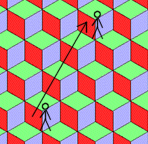 One way of getting at what it means to have a big symmetry group is
to think about moving yourself instead of moving the tiling. Pick any
tile in the infinite tiling, and imagine you are standing on the tile.
Look around at the surrounding tiling, and remember what it looks
like. Now pick a direction, and walk in that direction. As you walk
along stop at each tile you step on and look around, and ask yourself
if surrounding tiling looks exactly as it did on the original tile.
If it does, then you could pick the tiling up, retrace your steps,
and set it back down on itself so it exactly matches up.
One way of getting at what it means to have a big symmetry group is
to think about moving yourself instead of moving the tiling. Pick any
tile in the infinite tiling, and imagine you are standing on the tile.
Look around at the surrounding tiling, and remember what it looks
like. Now pick a direction, and walk in that direction. As you walk
along stop at each tile you step on and look around, and ask yourself
if surrounding tiling looks exactly as it did on the original tile.
If it does, then you could pick the tiling up, retrace your steps,
and set it back down on itself so it exactly matches up.
Now we have a good way to measure the size of a symmetry group. The
more directions you can walk and come to a place that looks like your
starting point, the bigger the group. A tiling has
wallpaper symmetry if no
matter which direction you go, you eventually come to a spot that looks
the same! If you compare the pictures below, the one on the right has
wallpaper symmetry, but in the one on the left, you could only walk
right or left if you wanted to come back to a place like your starting
point.
Fundamental Domains Revisited
A basic but important observation about symmetry is that symmetric
objects are usually assembled out of smaller pieces. For example, the
the picture on the right has rotational symmetry and is made out of
three identical red squiggles.

This is very natural when you think about how symmetry works. If
you can pick a symmetric figure and lay it back down on top of itself
so it matches up, there will generally be a lot of overlap. Even if you
throw away part of the overlap, the original figure and the shifted
figure will generally still give you back the whole picture.
The bigger the symmetry group, the smaller the piece that is
required to rebuild the tiling. The basic idea goes like this. Make
a list of all the symmetries of the tiling. In other words, list all
the ways the tiling can be shifted around so that it exactly matches
back up with itself. Now look for a small piece of the tiling that is
always shifted enough so that it doesn't overlap itself. If you
choose the right piece, like the shaded areas in the pictures above,
you can rebuild the entire tiling just by shifting that piece around
by every symmetry on your list! We can think of the symmetry group as
a set of "rules" instructing us how to tile the infinite plane with
the original tile.
If you think back, you will remember that the tiling on the left
has a relatively small symmetry group -- just translation to the right
and left -- while the wallpaper group has lots of symmetries. On the
other hand, it takes a whole vertical strip to rebuild the tiling one
the left. By contrast, the wallpaper tiling on the right can be
rebuilt from a single, small tile.
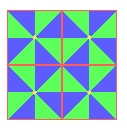 We began by
observing that wallpaper groups are big. The corresponding
fundamental domain fact is that for wallpaper tilings they consist of a single
tile. Mathematicians call the smallest piece of a tiling that can be
used to rebuild it the fundamental
domain. You may recall first that we first encountered
fundamental domains in the process of testing for periodic tilings. If you're looking for a
challenge, see if you can convince yourself that a periodic tiling is
the same thing as a tiling whose symmetry group is big enough to
contain a whole lattice's worth of translations. We began by
observing that wallpaper groups are big. The corresponding
fundamental domain fact is that for wallpaper tilings they consist of a single
tile. Mathematicians call the smallest piece of a tiling that can be
used to rebuild it the fundamental
domain. You may recall first that we first encountered
fundamental domains in the process of testing for periodic tilings. If you're looking for a
challenge, see if you can convince yourself that a periodic tiling is
the same thing as a tiling whose symmetry group is big enough to
contain a whole lattice's worth of translations.
Why Seventeen?
The fact that there are exactly seventeen wallpaper groups is a
wonderful and bizarre mathematical fact. The full mathematical
explanation is subtle and involved, but we can give a few ideas on the
subject here. The main point is that the any group of symmetries that
is big enough to have the wallpapering property, is big enough that is
has a single tile for its fundamental domain. As discussed in Triangle Tilings, there
are only a few choices for tile shapes that will actually fit together
and cover the plane, like a rectangle, an equilateral triangle, and so on.
Once you know you have a short list of fundamental domain shapes,
all you have to do is figure out how many ways you can put them
together. This is mostly a matter of listing what kinds of symmetries
you can use to glue together fundamental domains, and seeing how many
ways you can combine them.
|