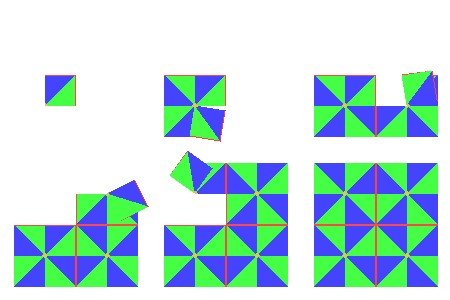
 The p4g symmetry group contains perpendicular reflections and 90
degree rotations.
The p4g symmetry group contains perpendicular reflections and 90
degree rotations.
 You can see the way that the p4g symmetry group works by watching how the
animation builds the tiling starting with the square tile shown on the
left. You rotate about the lower left corner and reflect across the red lines.
If you think about how these symmetries act on the entire tiling, you
can see that if you reflect over the red lines, or rotate 90 degrees
about any of the yellow points, the new tiling matches up with the
original perfectly. Therefore, we say the tiling as a while possesses
reflexive and four-fold symmetries.
You can see the way that the p4g symmetry group works by watching how the
animation builds the tiling starting with the square tile shown on the
left. You rotate about the lower left corner and reflect across the red lines.
If you think about how these symmetries act on the entire tiling, you
can see that if you reflect over the red lines, or rotate 90 degrees
about any of the yellow points, the new tiling matches up with the
original perfectly. Therefore, we say the tiling as a while possesses
reflexive and four-fold symmetries.
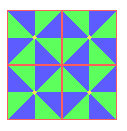
 To see that p4g tilings are also symmetric under
translations, imagine rotating and reflecting four copies of the original tile
to obtain the square to the right. You can then wallpaper the plane
with this larger square using only translations. After some thought
it is not difficult to see that this new wallpaper is the same as the
original tiling. This is just what we means when we say a tiling is
symmetric under translation. Sometimes such tilings are called periodic.
To see that p4g tilings are also symmetric under
translations, imagine rotating and reflecting four copies of the original tile
to obtain the square to the right. You can then wallpaper the plane
with this larger square using only translations. After some thought
it is not difficult to see that this new wallpaper is the same as the
original tiling. This is just what we means when we say a tiling is
symmetric under translation. Sometimes such tilings are called periodic.
Kali denotes this symmetry by "4*2". You can go to  now to experiment with symmetry p4g. now to experiment with symmetry p4g.
|