 The eighth wallpaper symmetry group is made up of glide reflections
and 180 degree rotations (half-turns). There are two glide
reflections and they are perpendicular to each other. Although the
example shown here uses a square tile, the pgg symmetry will wallpaper
the plane with any rectangle.
The eighth wallpaper symmetry group is made up of glide reflections
and 180 degree rotations (half-turns). There are two glide
reflections and they are perpendicular to each other. Although the
example shown here uses a square tile, the pgg symmetry will wallpaper
the plane with any rectangle.
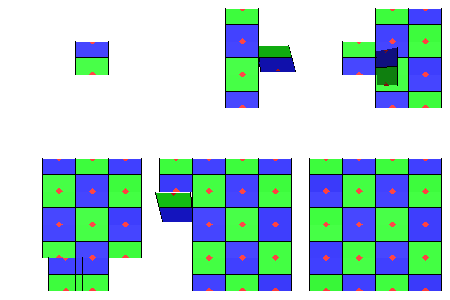
 Tilings with pgg symmetry are constructed as follows. Begin with the
tile on the left. Then build up a tiling by rotating about the red
points at the top and bottom of the square, and applying glide
reflections, as shown in the animation. The axis of the first glide
reflection is along the horizontal red line through the middle. For
the axis of the second glide reflection, you can use either vertical
edge.
Tilings with pgg symmetry are constructed as follows. Begin with the
tile on the left. Then build up a tiling by rotating about the red
points at the top and bottom of the square, and applying glide
reflections, as shown in the animation. The axis of the first glide
reflection is along the horizontal red line through the middle. For
the axis of the second glide reflection, you can use either vertical
edge.
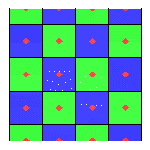 Notice if we rotate the
entire tiling (by 180 degrees) about any of the red points then it
lands back on itself, matching the original tiling perfectly. Hence,
this tiling has two-fold rotational symmetry. Similarly if
we glide refect the tiling along any of the horizontal or vertical
lines it lands back on it self and matches up, so we say the tiling is
symmetric with respect to the glide reflections. Notice if we rotate the
entire tiling (by 180 degrees) about any of the red points then it
lands back on itself, matching the original tiling perfectly. Hence,
this tiling has two-fold rotational symmetry. Similarly if
we glide refect the tiling along any of the horizontal or vertical
lines it lands back on it self and matches up, so we say the tiling is
symmetric with respect to the glide reflections.
 We can rotate and glide
reflect our original tile from above to build the large square on the
right. This new square, built from four copies of the original tile,
wallpapers the plane using just translations,
which is the p1 symmetry group. Since the new tiling constructed from
the larger tile matches the original pgg tiling, we see that pgg
tilings are symmetric under translations. This is another
way of saying it is a periodic tiling. We can rotate and glide
reflect our original tile from above to build the large square on the
right. This new square, built from four copies of the original tile,
wallpapers the plane using just translations,
which is the p1 symmetry group. Since the new tiling constructed from
the larger tile matches the original pgg tiling, we see that pgg
tilings are symmetric under translations. This is another
way of saying it is a periodic tiling.
Kali denotes this symmetry by "22o". You can go to  now to experiment with symmetry pgg. now to experiment with symmetry pgg.
|