 The seventeenth and final symmetry is the most complicated of all the
wallpaper symmetry groups. It contains the 2-, 3- and 6-fold
rotational symmetries that p6 has, and in
addition, it has reflections.
The seventeenth and final symmetry is the most complicated of all the
wallpaper symmetry groups. It contains the 2-, 3- and 6-fold
rotational symmetries that p6 has, and in
addition, it has reflections.
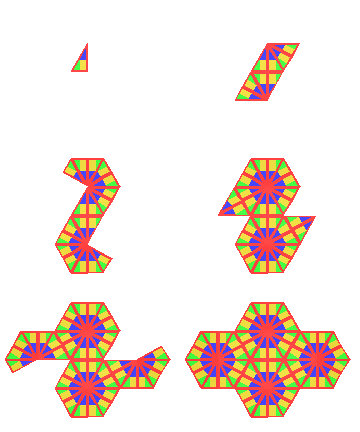
 The p6m tiling animation on the right starts with the
triangle to the left. This is a right triangle with 30 and 60 degree
angles (in addition to its 90 degree "right" angle). The p6m symmetry
group allows us to reflect across all sides of the triangle. In
addition, we can rotate by 60 degrees about the vertex with the 30
degree angle. Similarly, we can rotate by 120 degrees about the 60
degree vertex and rotate by 180 degrees about the right (90 degree)
vertex. However, as the animation illustrates, we don't actually have to
use any of the rotations -- we can wallpaper the plane with just the
refections.
The p6m tiling animation on the right starts with the
triangle to the left. This is a right triangle with 30 and 60 degree
angles (in addition to its 90 degree "right" angle). The p6m symmetry
group allows us to reflect across all sides of the triangle. In
addition, we can rotate by 60 degrees about the vertex with the 30
degree angle. Similarly, we can rotate by 120 degrees about the 60
degree vertex and rotate by 180 degrees about the right (90 degree)
vertex. However, as the animation illustrates, we don't actually have to
use any of the rotations -- we can wallpaper the plane with just the
refections.
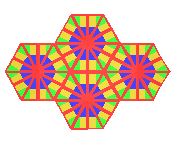 Since we can reflect the entire tiling through any of the red lines
and have it match back up with itself, we say this tiling is
symmetric under reflections. Similarly this tiling contains
6-, 3- and 2-fold rotational symmetry about those points where
or 6, 3 or 2 lines of reflection
intersect. If you know about isometries, you will see this happens because
doing two intersecting reflections
is the same as a rotation.
Since we can reflect the entire tiling through any of the red lines
and have it match back up with itself, we say this tiling is
symmetric under reflections. Similarly this tiling contains
6-, 3- and 2-fold rotational symmetry about those points where
or 6, 3 or 2 lines of reflection
intersect. If you know about isometries, you will see this happens because
doing two intersecting reflections
is the same as a rotation.
 As with the p6 tiling, we can choose a
hexagonal fundamental domain
like the one shown to the right, and produce the original p6 tiling
by translating it around. There is always such a fundamental domain
for wallpaper tilings, since they are periodic.
As with the p6 tiling, we can choose a
hexagonal fundamental domain
like the one shown to the right, and produce the original p6 tiling
by translating it around. There is always such a fundamental domain
for wallpaper tilings, since they are periodic.
Kali denotes this symmetry by "*632". You can go to  now to experiment with symmetry p6m. now to experiment with symmetry p6m.
|