 The sixteenth symmetry group is notable for containing 60 degrees rotations. Since a 60
degree rotation is a sixth of a full turn, p6 tilings have 6-fold
symmetry. This means these tilings must also have 2-fold and 3-fold
symmetry. To convince yourself of this, remember that having 6-fold
symmetry means that there are places in the tiling where we can
rotate it by 60 degrees and have the tiling match back up with itself.
But if we just rotate two or three clicks at a time, we will come back
to the original position after either three or two times, i.e 3-fold
and 2-fold symmtery respectively. All of this makes for a very
symmetric tiling!
The sixteenth symmetry group is notable for containing 60 degrees rotations. Since a 60
degree rotation is a sixth of a full turn, p6 tilings have 6-fold
symmetry. This means these tilings must also have 2-fold and 3-fold
symmetry. To convince yourself of this, remember that having 6-fold
symmetry means that there are places in the tiling where we can
rotate it by 60 degrees and have the tiling match back up with itself.
But if we just rotate two or three clicks at a time, we will come back
to the original position after either three or two times, i.e 3-fold
and 2-fold symmtery respectively. All of this makes for a very
symmetric tiling!
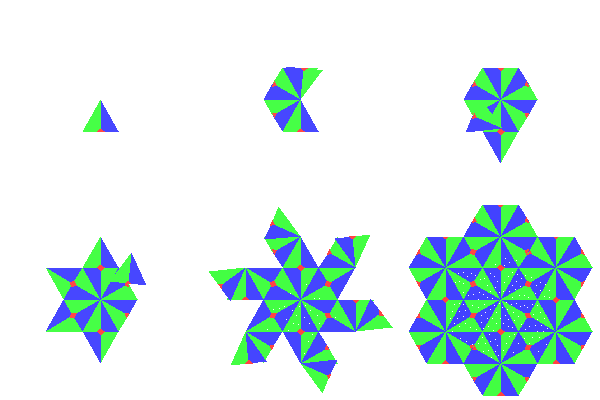
 In the animation, we begin with the triangle to the left, and then
rotate by 60 degrees about the blue/green vertex, by 120 degress about
the solid blue and green vertices, and by 180 degrees about the red
point. If we rotate the entire tiling about any of these points (by the
appropriate amount) then the rotated tiling matches up with the
original. In other words, these are the specific points that exhibit
the 2-, 3- and 6-fold symmetry of the tiling.
In the animation, we begin with the triangle to the left, and then
rotate by 60 degrees about the blue/green vertex, by 120 degress about
the solid blue and green vertices, and by 180 degrees about the red
point. If we rotate the entire tiling about any of these points (by the
appropriate amount) then the rotated tiling matches up with the
original. In other words, these are the specific points that exhibit
the 2-, 3- and 6-fold symmetry of the tiling.
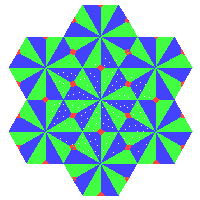
 Since all wallpaper tilings are periodic, we know that it must be possible
to build up a p6 tiling from a fundamental
domain, just by using translations. One possible fundamental
domain is the hexagon to the right, constructed out of six coppies of
the original tile.
Since all wallpaper tilings are periodic, we know that it must be possible
to build up a p6 tiling from a fundamental
domain, just by using translations. One possible fundamental
domain is the hexagon to the right, constructed out of six coppies of
the original tile.
Kali denotes this symmetry by "632". You can go to  now to experiment with symmetry p6. now to experiment with symmetry p6.
|