For most people, the idea of symmetry
conjures up thoughts of Art and Nature, as well as mathematics. Our
ideas of beauty are closely tied up with symmetry, and principles of
symmetry manifest themselves in subtle ways throughout the natural
world. Books like Design and Color in
Islamic Architecture : Eight Centuries of the Tile-Maker's Art and
Structure in
Nature Is a Strategy for Design pursue these connections in
greater detail.
For most people, the idea of symmetry
conjures up thoughts of Art and Nature, as well as mathematics. Our
ideas of beauty are closely tied up with symmetry, and principles of
symmetry manifest themselves in subtle ways throughout the natural
world. Books like Design and Color in
Islamic Architecture : Eight Centuries of the Tile-Maker's Art and
Structure in
Nature Is a Strategy for Design pursue these connections in
greater detail.
What is Symmetry?
Even though we all understand and recognize symmetry intuitively, it
is a little harder to say just what it is. However, in the plane, the
basic idea is clear enough:
A figure in the plane is symmetric
if you could pick up a copy of it, move it around to a new location
somehow, and set it back down on the original figure so that it
exactly matches up again.
The animations below illustrate this definition of symmetry in the
case of a checkerboard tiling. On the left, the tiling is just being
shifted or translated is such a
way that it matches up with itself again. On the right, the tiling is
being rotated a quarter turn to
make it match up again.
The checkerboard tiling is a very symmetric tilings.
There are lots and lots of ways of moving it on top of itself so that
it matches up again in addition to the two shown above.
Mathematicians say that different way of moving a tiling
onto itself is a "symmetry of the tiling". How many symmetries can
you think of for the checkerboard tiling?
Kinds of Symmetry
One of the first things to notice about symmetry is that there are
several different kinds. This is because there are different ways of
moving something in the plane. One way is to just translate it a
little. Another is to rotate it. Yet another is to turn it over.
As a consequence, there are different kinds of symmetry.
Consider the pictures above. The one on the left exhibits
rotational symmetry. You could pick
it up, rotate it a third of a circle, and set it back down so it would
exactly match up. The figure on the right has mirror symmetry. In this case, you could pick
it up, turn it over along the axis of the dotted line, and set it back
down on top of itself.
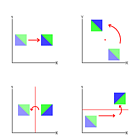 There
are actually four distinct kinds of symmetry, corresponding to four
basic ways of moving a tile around in the plane, illustrated to the
right. In mathematical language, these different ways of moving things
in the plane are called isometries. There
are actually four distinct kinds of symmetry, corresponding to four
basic ways of moving a tile around in the plane, illustrated to the
right. In mathematical language, these different ways of moving things
in the plane are called isometries.
To get a quick idea about how isometries work, you can look at some
animations of
translations,
rotations,
reflections, and
glide reflections,
or you can read about isometries in more depth in Introduction to
Isometries in the Science U library.
Symmetry Groups
 If a tiling has any symmetries at all, it usually has lots of them.
This is simply because if we do one symmetry followed by another, then
we could have just move the tiling directly from its initial postion
to its final position, and it would still match up. In other words,
the net effect of doing two symmetries one after the other is itself a
new symmetry. In mathematical language, we say that the
composition of two isometries
(i.e. symmetries) is again an isometry.
For example, as you can see on the left, if we flip
the checkerboard tiling twice, one in the x-direction, and once
in the y-direction, it has the same net effect as
rotating the tiling half a turn. (Focus on the purple square
for a landmark.)
If a tiling has any symmetries at all, it usually has lots of them.
This is simply because if we do one symmetry followed by another, then
we could have just move the tiling directly from its initial postion
to its final position, and it would still match up. In other words,
the net effect of doing two symmetries one after the other is itself a
new symmetry. In mathematical language, we say that the
composition of two isometries
(i.e. symmetries) is again an isometry.
For example, as you can see on the left, if we flip
the checkerboard tiling twice, one in the x-direction, and once
in the y-direction, it has the same net effect as
rotating the tiling half a turn. (Focus on the purple square
for a landmark.)
This pleasant fact makes it much easier to think about the
symmetry group for a tiling.
The symmetry group of a tiling is just the collection of all its
symmetries. If we think of the checkerboard tiling continuing on
forever in all directions, it is clear that it has infinitely many
symmetries. Just for starters, we could tranlate any even number of
squares in the x-direction or y-direction and the tiling
would still match up. This doesn't even count all the rotations and
other isometries which take it back onto itself.
In general, the more symmetric a tiling is, the larger its symmetry
group is. Indeed, as our checkboard example shows, symmetry groups
can be huge, infinite things. However, because we can compose
symmetries to get other symmetries, instead of thinking about
all symmetries, we need only think about a few basic ones
that we can compose with each other to get all the rest!
In the case of the checkerboard tiling, for example, instead of
thinking about all of the possible ways of translating it back on top
of itself, we can concentrate on two basic translations, one in the
x-direction and one in y-direction, as show above on the
left. We can get any other translational symmetry just by
doing these two enough times. For example, the diagonal translation
on the right is the same as the net effect of the two vertical and one
horizontal basic translations shown in the middle.
Mathematicians call such a
collection of basic symmetries the generators of the symmetry group.
As you will see, generators play an important role in classifying
different kinds of symmetry groups.
|