 The most eye-catching things about the p3 symmetry group is that it
contains 120 degree (or 3-fold) rotations. It is also the simplest
symmetry group containing 3-fold rotations.
The most eye-catching things about the p3 symmetry group is that it
contains 120 degree (or 3-fold) rotations. It is also the simplest
symmetry group containing 3-fold rotations.
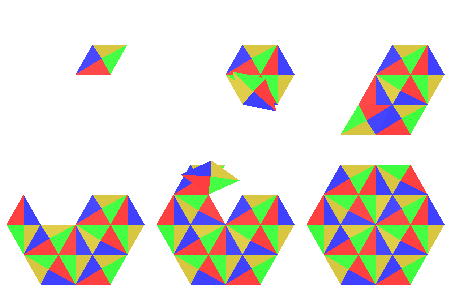
 As you can see from the animation, you build a p3 tiling from a
rhombus shaped tile, like the one shown on the left,
by reflecting the rhomb by 120 degrees about any of its four corners. At
the corner with the obtuse angle, rotating produces three copies of
the rhombus, which meet to
form a hexagon. On the other hand, at the corners with acutes angles,
rotating by 120 degrees leaves a gap between every other tile. These
gaps are filled by a second set of three tiles, which are also all 120
degrees apart from each other.
As you can see from the animation, you build a p3 tiling from a
rhombus shaped tile, like the one shown on the left,
by reflecting the rhomb by 120 degrees about any of its four corners. At
the corner with the obtuse angle, rotating produces three copies of
the rhombus, which meet to
form a hexagon. On the other hand, at the corners with acutes angles,
rotating by 120 degrees leaves a gap between every other tile. These
gaps are filled by a second set of three tiles, which are also all 120
degrees apart from each other.
Imagine you rotate the entire tiling by 120 degrees about any of
these corners. You see that the rotated tiling matches the original
perfectly - it is as if the tiling was never moved. We say the
tiling as a whole has 3-fold symmetry.

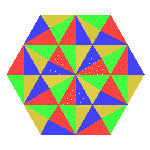 Surprisingly, even though p3 tilings are contructed using only
rotations, they also have translational symmetry. If you rotate a
copy of the original tile around one of the red/green corners three
times, you get a hexagon like the one shown on the right. You can
then wallpaper the plane with this hexagon using only translations,
recreating the original tiling. See if you can visualize how this
works!
Surprisingly, even though p3 tilings are contructed using only
rotations, they also have translational symmetry. If you rotate a
copy of the original tile around one of the red/green corners three
times, you get a hexagon like the one shown on the right. You can
then wallpaper the plane with this hexagon using only translations,
recreating the original tiling. See if you can visualize how this
works!
Kali denotes this symmetry by "333". You can go to  now to experiment with symmetry p3. now to experiment with symmetry p3.
|