 This symmetry group is part of a series of tilings all based on the p3 tiling (p3 is just 120 degree rotations). The
p31m symmetry group is slightly different, because it also
contains reflections in addition to 120 degree rotations.
This symmetry group is part of a series of tilings all based on the p3 tiling (p3 is just 120 degree rotations). The
p31m symmetry group is slightly different, because it also
contains reflections in addition to 120 degree rotations.
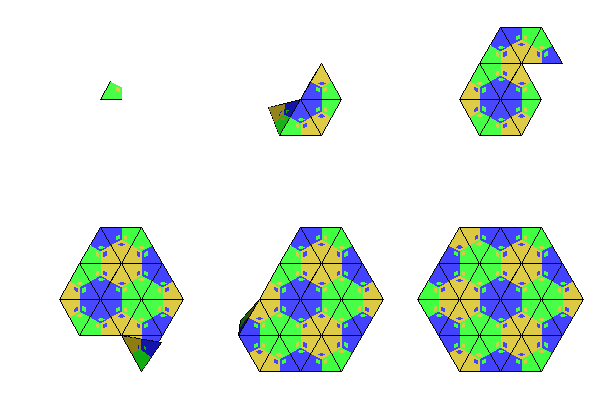
Illustrating this symmetry group is a little more complicated, so
in the animation, we will mostly move around triangles made up out of
three copies of the basic tile or fundamental
domain shown above on the left. Let's call this tile a "kite".
 We can rotate this tile twice by 120 degrees to obtain the triangle
shown to the left. We have color coded the three copies of the kite
tile to make them easier to see. Using the reflections in p31m, we
then wallpaper the plane by reflecting the triangle over its three
edges. Take a moment to convince yourself that we end up constructing
the same tiling with the triangle as we would if we wallpapered with
the three times as many kite tiles by reflecting them about their red
edges and rotating about the marked corner.
We can rotate this tile twice by 120 degrees to obtain the triangle
shown to the left. We have color coded the three copies of the kite
tile to make them easier to see. Using the reflections in p31m, we
then wallpaper the plane by reflecting the triangle over its three
edges. Take a moment to convince yourself that we end up constructing
the same tiling with the triangle as we would if we wallpapered with
the three times as many kite tiles by reflecting them about their red
edges and rotating about the marked corner.
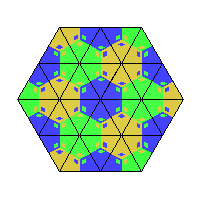 The tiling as a whole has reflexive and 3-fold symmetry as
you can see by reflecting it across any red line, or rotating by 120
degress around any of the points where reflection lines meet.
The tiling as a whole has reflexive and 3-fold symmetry as
you can see by reflecting it across any red line, or rotating by 120
degress around any of the points where reflection lines meet.
When imagining shifting the tiling as a whole, you have to take the
coloring into account when trying to decide if the shifted tiling
matches up with the original. It is okay if one kite lands on another
kite of a different color, but only if all the colors are shifted in
the same, systematic way.
The thing to pay attention to is the order
of the colors as you go around a triangle.
For example, if the blue kites wind up on top of yellow
kites, then yellow kites must end up on green kites. In other words,
all the colors must shift in the clockwise direction as you go
around one of the triangle. This is important, since there are
actually ways of picking the tiling up and puttting it back down again
so that the order the colors are in gets reversed as you go
clockwise around a triangle. Can you think of one of these
"color orientation" reversing transformations?
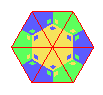 As with all of the wallpaper tilings, p31m tilings are periodic, which is the same as saying they
are symmetric under translations. To see this,
use the p31m symmetries to constuct the tile shown on the right. We can
use just translations to wallpaper the plane with this tile to obtain
the original tiling.
As with all of the wallpaper tilings, p31m tilings are periodic, which is the same as saying they
are symmetric under translations. To see this,
use the p31m symmetries to constuct the tile shown on the right. We can
use just translations to wallpaper the plane with this tile to obtain
the original tiling.
Kali denotes this symmetry by "3*3". You can go to  now to experiment with symmetry p31m. now to experiment with symmetry p31m.
|