|
Animating a triangle amounts to giving coordinates for its vertices
at each frame of the animation. Although the idea behind this is
simple, finding the right coordinates to give by trial and error just
isn't practical. Therefore, what we really need is something a
computer can do for itself. In other words, we need
formulas.
To compute the locations of verticies for animations, we require a
special kind of formula, however, that takes in the coordinates of a
point, and gives us back the coordinates of the new point. Such a
formula is generically called a transformation. Here are two such formulas:
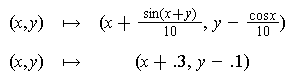
Thus, for example, the second transformation maps the point (1,1) to
the point (1.3, .9).
Once we are armed with formulas, our procedure for animating a
triangle becomes fairly straightforward, from the point of view of a
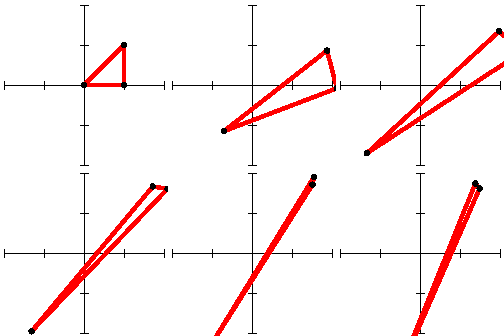
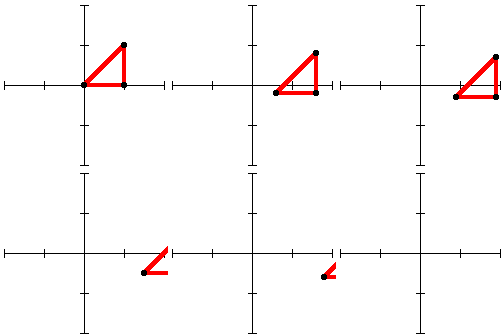
computer anyway. The procedure and the results of applying it with
the two formulas given above are shown below:
- start with three points, e.g (0,0), (1,0) and (1,1)
- draw the triangle connecting the three points
- use a transformation formula to map each of the three
points to three new points
- goto step 2 and repeat
|
|
No doubt, the first thing that leaps out at you about the first
animation is that we aren't really moving the triangle so
much as distorting it. By contrast, the second animation "toes the
line" nicely, without any unruly distortion.
Next:
Distortion free transformations in "Hendrix meets Euclid"
|