|
In order to automate the process of animation with a computer, the
computer needs to be able to automatically update the location of
moving objects at each frame. In practical terms, the computer needs
a formula for computing the new location of a point. In other words,
the computer requires a special kind of function which takes in the
coordinates of a point, and spits out the coordinates of a new,
transformed point. In math, such functions are called
transformations.
In day to day life, we encounter transformations all the time;
anytime you pick up your coffee cup and randomly set it down somewhere
else, there is a transformation lurking behind the scenes that
describes the move from the old position to the new position.
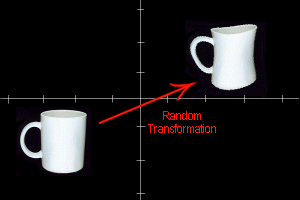
However, the transformations we encounter in the physical world are
very special. Moving your coffee cup randomly may make it hard to
find, but it will still be pretty much the same ol' cup it always used
to be. By contrast, in mathematics or computer graphics, picking a
transformation at random is almost certain to distort objects as they
move.
Consequently, for computer animation, the transformations we are
most interested in are the distortion-free ones, which correspond to
motion in the physical world. Such transformations are called
isometries, coming from the Greek, meaning roughly equal
measures. However, knowing we want isometries is one thing, while
actually finding formulas is another. In fact, even capturing the
idea of "distortion-free" in quantifiable, mathematical terms leads to
some interesting subtleties.
Next:
Some isometry issues in "Spacetime Subtleties"
|