|
Isometries are transformations that don't distort the shapes of
objects in the process of moving them. The mathematical definition of
an isometry is a transformation which preserves distances.
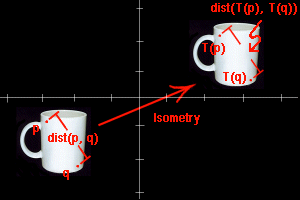
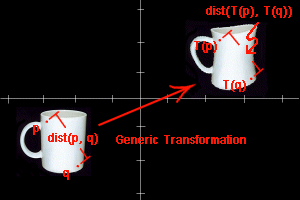
That is, with an isometry, the distance between any two points
p and q in the original image is the same as the
distance between the corresponding points T(p) and
T(q) in the transformed image. By constract, with a generic
transformation, there will be some points p and q for
which the distance between the corresponding transformed points either
shrinks (as illustrated above) or grows.
Our everyday experience gives us a pretty good intuitive idea of
what "distortion free" ought to mean. However, one of the major
achievements of 19th century geometry was the realization that a lot
goes into really pinning down what you mean by "distortion free".
Subtle changes in your idea of distortion quickly lead to completely
new, non-Euclidean geometries.
As an example, one good way of looking at Einstein's theory of
special relativity is to regard it as a reformulation of what a
"distortion free" transformation of space is. The basic idea is that
your sense of "distortion" depends on how fast you are moving relative
to the object you are trying to measure, and thus both space and time
are involved. One ends up considering transformations of "spacetime."
Of course, one doesn't need to understand special relativity to
animate a teapot. However, some subtleties are unavoidable.
Even convincing yourself that a transformation which "preserves
lengths" is the same as a "distortion-free" mapping takes a bit of
thought. For example, why can't you have a transformation which
preserves lengths but distorts angles?
Next: Would the real isometry please stand up?"
|