|
Dissection Problems in History
Just before the turn of this century, mathematicians began holding
an international congress. During the second such international
congress, held in Paris in 1900, a famous
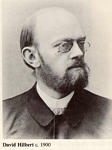
mathematician David Hilbert read a list of mathematical
problems. These problems where tremendously influential, and partly as
a result, Hilbert is now one of the most prominent
mathematicians in history.
Hilbert had a very broad and profound knowledge of mathematics and physics,
and he thought of 23 problems, posed as challenges, might be a good
motivation for mathematical research in the new century. Most of the
problems he proposed were aimed at developing general programs. The third
problem, however, was simple to state and understand, asking only if a
counterexample to a theory could be found.
In 2-dimensional Euclidean geometry, areas of polygons can be
computed by cutting them into pieces and pasting into polygons of know
sizes, in much the same way that we illustrated the Pythagorean
Theorem on the previous page. Hilbert did not believe that a general
theory of volume can be based on the idea of cutting and pasting.
In particular, he thought that it should be possible to find two
tetrahedra with equal volumes with the property that you couldn't cut
up the first one into tetrahedra and then reassemble the pieces to get
the second one.
Here is a partial translation of his (more precise, and thus more
difficult) statement of the problem:
"Gauss mentions in particular the theorem of Euclid that tetrahedra
of equal altitudes their volumes are proportional as their
bases. ... Gerling succeded in proving the equality of volume of
symmetrical polyhedra by dividing them into congruent
parts. Nevertheless, it seems to me probably that a general proof of
the kind for the Euclid's theorem is impossible, and it should be our
task to give a rigorous proof of its impossibility. This would be
obtained as soon as we specify two tetrahedra of equal bases and
altitudes which can not be split up into congruent tetrahedra and
which cannot be combined with congruent tetrahedra to form two
polyhedra which themselves could be split up into congruent
tetrahedra."
Some of Hilbert's famous problems have still not been solved, but
not this one. Max Dehn found the solution a few months after it was
posed. Surprisingly, it turns out that two fairly commonplace
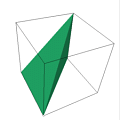
tetrahedra will work as the counterexamples Hilbert asked for. In
particular, the tetrahedra pictured below, with vertices at
{(0,0,0),(1,0,0),(0,1,0),(0,0,1)}

{(0,0,0),(1,0,0),(0,1,0),(0,1,1)}
solve the problem.
|