|
Modern Decomposition Problems
Eventhough Hilbert's challenge problem about decomposing tetrahedra
didn't take very long to solve, there are still many unsolved problems
about tetrahedral decompositions of other Platonic Solids besides the
tetrahedron.
Earlier in this article we posed the problem of finding the largest
and smallest number of tetrahedra that can be used in a decomposition.
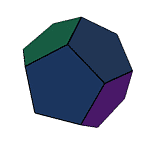
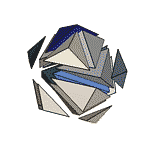
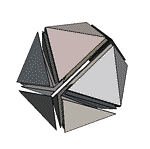
The series of pictures below show the
most economical way of decomposing a regular dodecahedron into
tetrahedra.
Here is an animation showing the minimal decomposition for the
dodecahedron.
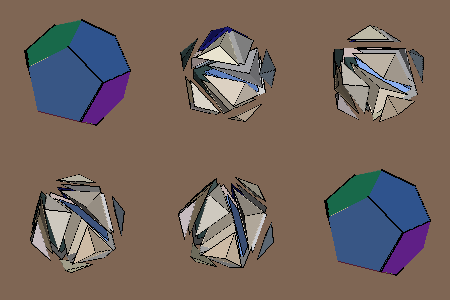
A similar problem is to find the decomposition with
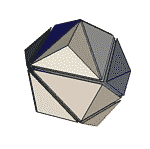
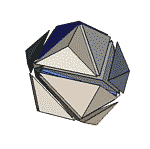
the largest number of tetrahedra. The
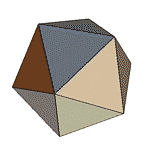
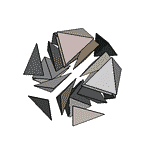
pictures below show the decomposition with the maximal
number of tetrahedra for the icosahedron.
For mathematicians, who love generality and abstraction, the most
interesting problem of all is coming up with a general method of find
the largest or the smallest tetrahedralizations for a polyhedron.
This is complicated question -- researchers have tried
for many years just to understand the minimal decompositions of higher
dimensional analogues of a cube, which actually has practical
applications.
Recently, however, researchers at the Geometry Center of the
University of Minnesota developed general techniques to compute such
minimal decompositions. The fundamental insight is that the collection
of all tetrahedralizations can in fact be thought of as a large
polyhedron, called Universal Polytope, that lives in high
dimensions. Studying this strange, abstract, other-worldy object
leads to a way of finding optimal tetrahedralizations.
|