Dissection Problems
Do you ever feel like breaking things apart? Then maybe
mathematical dissection problems are just the thing for you!
Dissection problems are about cutting things into pieces and
reassembling them.
 One of the oldest and most famous examples of a
dissection problem is the Pythagorean
Theorem. In modern language, the pythagorean theorem is usually
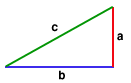
stated in terms of algebra: Given a right triangle with sides
labeled as shown above on the right, a2 + b2 =
c2.
One of the oldest and most famous examples of a
dissection problem is the Pythagorean
Theorem. In modern language, the pythagorean theorem is usually
stated in terms of algebra: Given a right triangle with sides
labeled as shown above on the right, a2 + b2 =
c2.
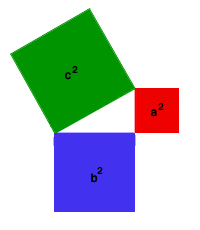
 However, if we think geometrically, a2,
b2 and c2 are just the areas of
the squares shown in the figure on the left. The theorem then becomes a
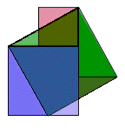
dissection problem -- how do we cut up the little squares into pieces
which exactly fill the larger square? One answer is shown here:
However, if we think geometrically, a2,
b2 and c2 are just the areas of
the squares shown in the figure on the left. The theorem then becomes a
dissection problem -- how do we cut up the little squares into pieces
which exactly fill the larger square? One answer is shown here:
Polyhedral Decompositions
 The Pythagorean Theorem is an ancient dissection problem. A more
modern family of problems have to do with cutting up 3D polyhedra.
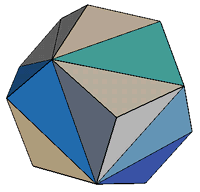
For example, the picture on the right shows how to cut up
a dodecahedron into piece which are all tetrahedra.
The Pythagorean Theorem is an ancient dissection problem. A more
modern family of problems have to do with cutting up 3D polyhedra.
For example, the picture on the right shows how to cut up
a dodecahedron into piece which are all tetrahedra.
Mathematicians call a way of cutting up a polyhedron a
decomposition. But what is a decomposition anyway? You
could reasonably call lots of ways of cutting up a polyhedron a
decomposition, but mathematicians have a very precise notion of what
this means.
For one thing, you aren't allowed cut up your polyhedron into
infinitely many pieces. Of course, in the real world, this is not
much of a restriction! More importantly, to be a decomposition, the
pieces have to fit together in a particularly nice way:
- There can't be any gaps or chinks.
- All the vertices of the pieces should coincide with the vertices
of the origial polyhedron.
- The pieces shouldn't partially overlapping each other. That is,
if two pieces touch at all, they should touch along an entire edge or
face, unless they just touch at a vertex.
Tetrahedral Decompositions
In the plane, the simplest and most basic polygon is the triangle,
since you can't really have a polygon with just two sides. Thus, in
the plane, dissection problems frequently involve cutting things up
into triangles.
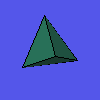 In 3-dimensional
space, the simplest polyhedron is called a tetrahedron. A
tetrahedron is a polyhedron with just 4 faces. A regular tetrahedron,
from Platonic and
Archimedian Solids pages, is pictured on the right. You can
experiment with an interactive
Java version of this tetrahedron as well, to get a better idea of
its 3-dimensional shape. In 3-dimensional
space, the simplest polyhedron is called a tetrahedron. A
tetrahedron is a polyhedron with just 4 faces. A regular tetrahedron,
from Platonic and
Archimedian Solids pages, is pictured on the right. You can
experiment with an interactive
Java version of this tetrahedron as well, to get a better idea of
its 3-dimensional shape.
Since tetrahedra are the simplest, building-block polyhedra, it is
natural to ask questions about decomposing other polyhedra into
tetrahedra. Here are some examples:
- What is the smallest number of tetrahedra needed to decompose a
cube?
- What is the largest number of tetrahedra that can be used to
decompose a cube?
- How many different ways are there to decompose a cube into tetrahedra?
We posed these questions about cubes, since they are also very
simple polyhedra. You can try you hand at them by building your own
tetrapuzzle pieces and trying to make a cube. However, we could
obviously use any other kind of polyhedron as well -- a dodecahedron,
an icosahedron,
etc.
These questions are so basic and obvious, you would think they had
been answered long ago. However, you would be wrong. These questions
and many others like them turn out to be surprisingly difficult.
|