|
The Moon is the most noticeable object in the night sky, and it is then
no wonder that it has fascinated mankind since antiquity.
If you observe it for several days, you will no doubt notice
that its appearance changes: most of the time only part of it is
illuminated, and this part seems to grow until it covers the whole
moon (full moon) and then decrease until nothing is illuminated
(new moon), and then grow again, in a cycle that repeats about
every month.
One possible explanation that comes to mind is that the dark part
we see on the Moon is the shadow that the Earth casts on it. But
there are problems with this explanation. For one, if this were true,
the Moon should be in its new phase when it at its farther from the Sun.
We know when this happens, because then the Moon rises at the same time
as the Sun sets; and we can observe that at this point the Moon is full, not new!
Besides, if the Moon passes through the Earth's shadow every month,
then when it is at the opposite side of its orbit it should get
directly in between the Sun and the Earth, producing a
solar eclipse much more often than it actually happens.
No, this explanation cannot be the right one.
Why does the Moon have phases, then?
The Moon does not emit light on its own; all the moonlight we see
is actually light coming from the sun that is reflected on the moon
surface. The part of the Moon that is illuminated is the half that is
facing the Sun. But from here, the Earth, we cannot always see that same
half; instead, we see only the half facing us. The parts of the Moon that
are on both halfs (the illuminated one, and the half facing Earth) are
the parts that we can actually see from here.
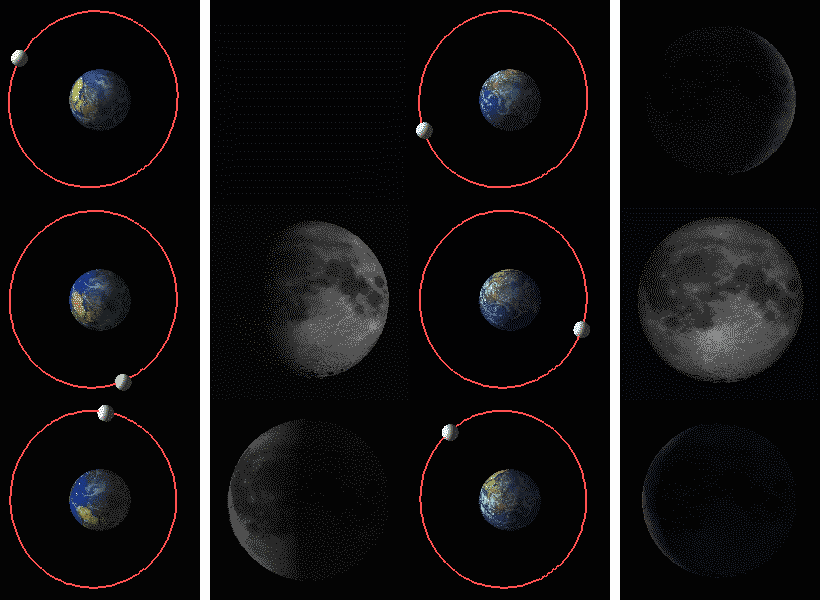 |
Position of the Moon in orbit (left) and its corresponding phase (right)
(The Sun is initially in the upper-left direction) |
- When the Moon is roughly in the same direction as the Sun, its illuminated
half is facing away from the Earth, and therefore the part that faces
us is all dark: we have the new moon. When in this phase, the Moon
and the Sun rise and set at about the same time.
- As the Moon moves around the Earth, we get to see more and more of the
illuminated half, and we say the Moon is waxing.
At first we get a sliver of it, which grows as days go by. This phase is
called the crescent moon.
- A week after the new moon, when the Moon has completed about a quarter of
its turn around the Earth, we can see half of the illuminated part; that is,
a quarter of the Moon. This is the first quarter phase.
- During the next week, we keep seeing more and more of the illuminated
part of the Moon, and it is now called waxing gibbous (gibbous
means "humped").
- Two weeks after the new moon, the moon is now halfway through its revolution,
and now the illuminated half coincides with the one facing the Earth, so
that we can see a full disk: we have a full moon. As mentioned
above, at this time the Moon rises at the time the Sun sets, and it sets
when the Sun rises. If the Moon happens to align exactly with the Earth and
Sun, then we get a lunar eclipse.
- From now on, until it becomes new again, the illuminated part of the
Moon that we can see decreases, and we say it's waning. The first
week after full, it is called waning gibbous.
- Three weeks after new, we again can see half of the illuminated part.
This is usually called last quarter.
- Finally, during the fourth week, the Moon is reduced to a thin sliver
from us, sometimes called waning crescent. A while after four weeks
(29.5 days, more precisely) the illuminated half of the Moon again faces
away from us, and we come back to the beginning of the cycle: a new moon.
Sometimes, when the Moon is almost new, it is possible to dimly see its
darkened disk. The light from the Sun cannot reach this part of the Moon
directly; but at this time the Earth (as viewed from the Moon) is at its
full and very bright, and what we see is light reflected from the Earth,
that then bounces back at us from the Moon.
It's a long trip for this light: from the Sun to the Earth, to the Moon,
and back to the Earth. No wonder it's not enough to really illuminate the Moon!
Now, if all planets revolve around the sun, shouldn't other planets
also present phases? The answer is yes, and the fact that Venus has
different phases was one of the arguments in favor of putting the Sun
in the center of the Solar System, and not the Earth (as it was believed
before). The phases of Venus are similar to those of the Moon, only that
to complete a cycle we have to wait until the relative positions of Venus
and the Earth repeat.
This takes much longer than for the Moon: it's about 20 months.
|