|
The four basic types of isometries of the plane (sometimes called
rigid motions because they do not distort shapes) are translation,
rotation, reflection and glide reflection. A little experimentation
moving piece of paper around a table top should lead you to
strongly suspect that these are the only kinds of isometries.
However, it frequently takes a minute to see how you can accomplish
some sequence of transformations in one single operation from our
list. In fact, it can easily be so obscure that we are left with a
nagging doubt that there might some some other exotic isometries that
only arise as a complicated sequence of transformations.
What happens when you do one isometry followed by another?
Obviously the result is another isometry, since neither transformation
introduces any distortion. The question is whether or not it is
already on our list. To make things more concrete, consider reflections.
If we do one reflection followed by another, notice the result will have
to be orientation-preserving; doing the first reflection will
produce a mirror image, but the second reflection will do a mirror
image of a mirror image -- that is, we will return to our original
orientation. That suggests a product of reflections should be either
a translation or a rotation.
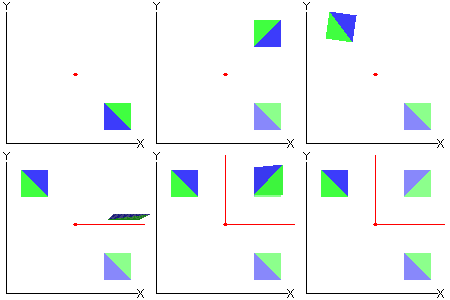
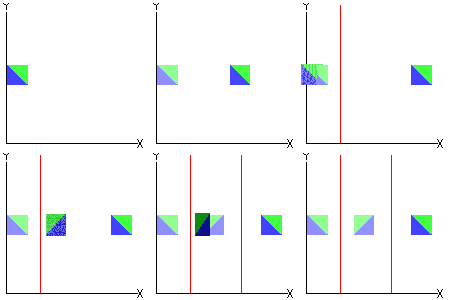
In fact, this is exactly what happens. Which type you get depends
on whether or not the mirror lines of the two relfections cross.
You should be able to figure out which is which just by noticing
that if the mirror lines cross, the intersection point will be a fixed
point of the product, since neither reflection will move this point.
This leads us to a fascinating conclusion. Since we can emulate
the effect of translation by doing two reflections, you should be able to
see how we can also emulate the effect of a glide reflection by doing
three. As a result, we can really just focus on the behavior of
reflections, since the other three types of isometry can be built up
from reflections.
Next: "Closing the Ring"
|