|
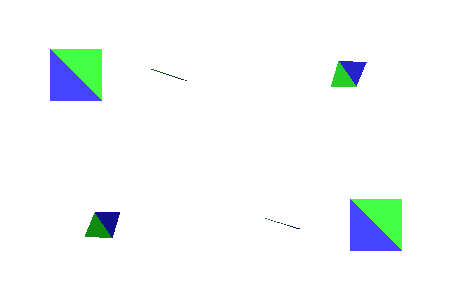
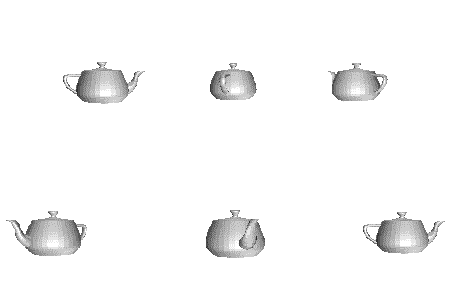
What do teapots and triangles have in common? If you said
"nothing" you must have something against the letter "t". However,
the correct answer for the day is that computer animations of
teapots and triangles both boil down to the same basic geometric
transformations, called isometries.
One way of looking at geometry is to think about shapes and sizes.
Triangle, circles, cones, and so on, come up again and
again in science, industry and commerce. When most of us first
encounter geometry, we learn formulas and theorems describing useful
and interesting properties of these shapes. Indeed, it was probably
the need to compute weights and volumes that led merchants and
traders to think about geometry formulas nearly 3000 years ago,
and elaborating the study of shapes and sizes dominated geometers for
the next several millenia.
However, starting in the 19th century, another way of looking at
geometry emerged. The idea was to focus on how to manipulate and
transform geometric objects instead of focusing on the objects
themselves. This proved to be very effective, and rapidly lead to
discoveries about non-Euclidean geometries, the theory of relativity,
and even computer graphics.
Next:
A closer look at computer graphics in "Geometry
goes to Hollywood".
|